Trigarta Kingdom: Ancient History, King Susharma Chandra, Three Rivers & Kangra Fort
The definitive research chronicle of the Trigarta Kingdom (त्रिगर्त)—one of the world's oldest surviving sovereign dynasties, encompassing the river basins of the Ravi, Beas, and Sutlej, the martial confederacy of the Mahabharata, and the imperial fortresses of Jalandhar and Kangra.
Quick Answer: What was the Trigarta Kingdom?
The Trigarta Kingdom was an ancient Indian martial kingdom and republic (Ayudhajivi Sangha) centered between the Shiwalik Himalayas and the fertile plains of Punjab. Mentioned in the Mahabharata, Puranas, and Panini's Ashtadhyayi (5th century BCE), it was governed by the Katoch dynasty and derives its name from the three great Himalayan rivers that fed its territory: the Ravi (Iravati), Beas (Vipasha), and Sutlej (Shatadru).
- Founding Monarch: Maharaja Bhuma Chand (born of the brow of Goddess Ambika in Jwalamukhi lore).
- Mahabharata War Commander: King Susharma Chandra (led the Samsaptaka warrior corps against Arjuna).
- Dual Capitals: Jalandhara (plains/winter capital) and Nagarkot / Kangra Fort (mountain/summer stronghold).
- Numismatic Coins: 2nd–1st century BCE copper coins inscribed with Brahmi: "Trakata-janapadasa".
- Modern Territory: Kangra, Hamirpur, Una, Kullu (Himachal Pradesh) & Jalandhar, Hoshiarpur (Punjab).
Mathematical & Geographical Topology: The Set of Three Rivers
In classical Sanskrit etymology and discrete geographic set theory, Trigarta is formally partitioned as the hydrological intersection set bounded by three fluvial vectors:
This tripartite fluvial partition formed one of the most defensible natural ramparts in human history:
King Susharma Chandra: The Epic Mahabharata War & The Samsaptakas
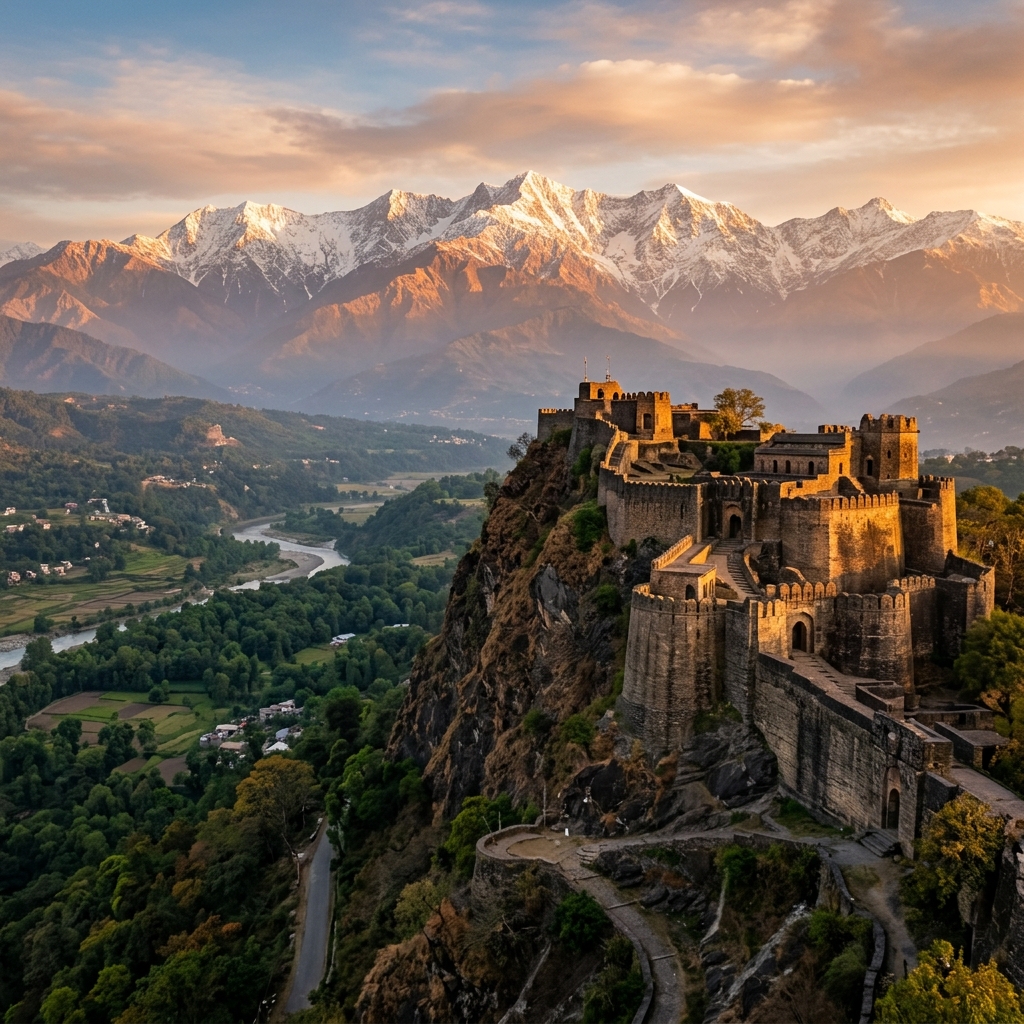
The most famous monarch in Trigarta’s early dynastic annals is King Susharma Chandra (the 234th ruler of the Katoch line). His political and military actions are extensively chronicled in the Virata Parva, Udyoga Parva, and Drona Parva of Vyasa’s Mahabharata:
1. The Cattle Raid of Matsya Kingdom (Go-Grahana)
During the 13th year of the Pandavas’ exile (their Agyatvas or incognito period in the kingdom of King Virata of Matsya), King Susharma Chandra orchestrated a coordinated invasion from the south. Driven by historical grievances over Matsya cattle raids, Susharma attacked first to draw Virata’s army away, allowing the Kaurava host under Bhishma and Duryodhana to advance from the north. This clash precipitated the reveal of Arjuna (Brihannala) and Prince Uttara.
2. The Samsaptaka Oath (The Suicide Vanguard)
On the battlefield of Kurukshetra, King Susharma Chandra was chosen by Dronacharya to execute one of the most perilous tactical missions: keeping Arjuna away from the main combat zone so that Drona could form the impregnable Chakravyuha (which ultimately led to the fall of Abhimanyu).
Susharma and his Trigarta brothers took the solemn Samsaptaka vow before sacrificial fires—an oath binding them to fight until either they killed their designated foe or perished to the last man. Susharma fought with extraordinary valor, utilizing celestial weapons including the Vayavya Astra against Arjuna, before meeting his heroic end in combat.
3. Construction of Nagarkot (Kangra Fort)
Following the conclusion of the Kurukshetra war, the surviving members of the royal family consolidated their domain in the hills. King Susharma Chandra is traditionally credited with commissioning the core ramparts of Nagarkot (Kangra Fort) on a high precipitous bluff over the Banganga and Majhi rivers, creating an unassailable bastion that endured for thousands of years.
The Dual Capital System: Jalandhara & Nagarkot
Centuries ahead of administrative dual-capital models, the rulers of Trigarta exercised governance through seasonal and geopolitical dual nodes:
🏛️ Jalandhara (Plains Capital)
- Location: Modern Jalandhar city in Punjab Doab.
- Season: Winter headquarters • agricultural revenue administration.
- Economic Engine: Bustling crossroads of the Uttarapatha trade superhighway connecting Taxila, Gandhara, and Pataliputra.
- Puranic Lore: Named after the mythological demon-king Jalandhara, whose body is symbolically laid across the Doab.
🏰 Nagarkot / Kangra Fort (Citadel)
- Location: Modern Old Kangra, overlooking Banganga Gorge.
- Season: Summer seat • wartime military bastion • treasury vault.
- Defensibility: Surrounded by steep vertical cliffs; withstands prolonged multi-year sieges.
- Spiritual Core: Revered seat of Mata Brajeshwari Devi (Kangra Devi Shaktipeeth).
Archaeological Proof: Trigarta Coins, Inscriptions & Classical Records
The existence of Trigarta is not merely legendary—it is corroborated by rigorous epigraphical, numismatic, and classical literary evidence:
- Numismatic Discovery (Trigarta Janapada Coins): Rare copper and bronze punch-marked and cast coins discovered in the Kangra-Hoshiarpur belt, dated to the 2nd–1st century BCE, bear legends in early Brahmi and Kharosthi scripts: "Trakata-janapadasa" (त्रिकत जनपदस). These coins depict temples, tridents, and sacred trees inside railings.
- Panini's Ashtadhyayi (5th Century BCE): Great Sanskrit grammarian Panini explicitly lists Trigarta among the Ayudhajivi Sanghas—autonomous warrior-republics where citizenship was bound to martial military service. Panini designates the confederacy as the Trigarta-Shashtha (confederacy of six clans: Kauntoratha, Dandaki, Kraustuki, Jalaki, Brahmagupta, and Janaki).
- Alexander the Great’s Campaign (326 BCE): Greek historians Arrian and Curtius document that Alexander’s troops mutinied and refused to cross the Hyphasis (Beas River) precisely at the boundary of Trigarta, intimidated by the reports of large standing armies of war elephants and seasoned hill infantries awaiting them.
- Kalhana’s Rajatarangini: The 12th-century historical chronicle of Kashmir repeatedly records royal matrimonial alliances and military skirmishes between the kings of Kashmir (such as Lalitaditya Muktapida and Ananta) and the rulers of Trigarta.
- Baijnath Temple Prashasti Inscriptions (1204 CE): Stone inscriptions in the famous Baijnath Shiva Temple refer to the local chieftain Lakshmana and acknowledge allegiance to King Jayachandra of Trigarta.
Chronological Evolution of the Trigarta-Katoch Lineage
How to Explore the Trigarta Heritage Today
Travelers and heritage seekers exploring Himachal Pradesh can physically walk the ancient grounds of Trigarta through these core itineraries:
1. Kangra Fort (Nagarkot)
Walk the 21 historic gates, explore the ancient Ambika and Lakshmi Narayan temples, and visit the Maharaja Sansar Chand Royal Museum.
2. Masroor Rock-Cut Temples
Monolithic 8th-century rock-hewn temples overlooking the Dhauladhar, representing the height of classical Trigarta architectural ingenuity.
3. Sujanpur Tira & Nadaun
Explore the Beas riverfront palace grounds, the grand Chaugan, and original frescoes where the later Trigarta-Katoch kings governed.
Frequently Asked Questions: Trigarta Kingdom
Q1: Which modern Indian states were part of the Trigarta Kingdom?
The territory of Trigarta spanned modern-day Himachal Pradesh (specifically the districts of Kangra, Hamirpur, Una, Bilaspur, and parts of Mandi & Kullu) and Punjab (the Doaba region including Jalandhar, Hoshiarpur, and Kapurthala).
Q2: Why did Alexander the Great turn back near Trigarta?
When Alexander reached the Hyphasis (Beas River) bordering Trigarta in 326 BCE, his war-weary soldiers refused to proceed further after hearing reports of formidable mountain armies and war elephant contingents assembled beyond the river.
Q3: Is the Katoch dynasty the oldest surviving dynasty in India?
Yes. The Katoch dynasty of Trigarta is documented by historians as one of the oldest recorded continuous royal dynasties in the world, with lineage chronicles cataloging over 480 continuous generations of kings.
Q4: What language was spoken in ancient Trigarta?
In ancient times, classical Sanskrit and regional Prakrits were spoken, written in Brahmi and Kharosthi scripts on coins. Over centuries, these evolved into the modern Western Pahari dialects (Kangri, Dogri) and Punjabi.